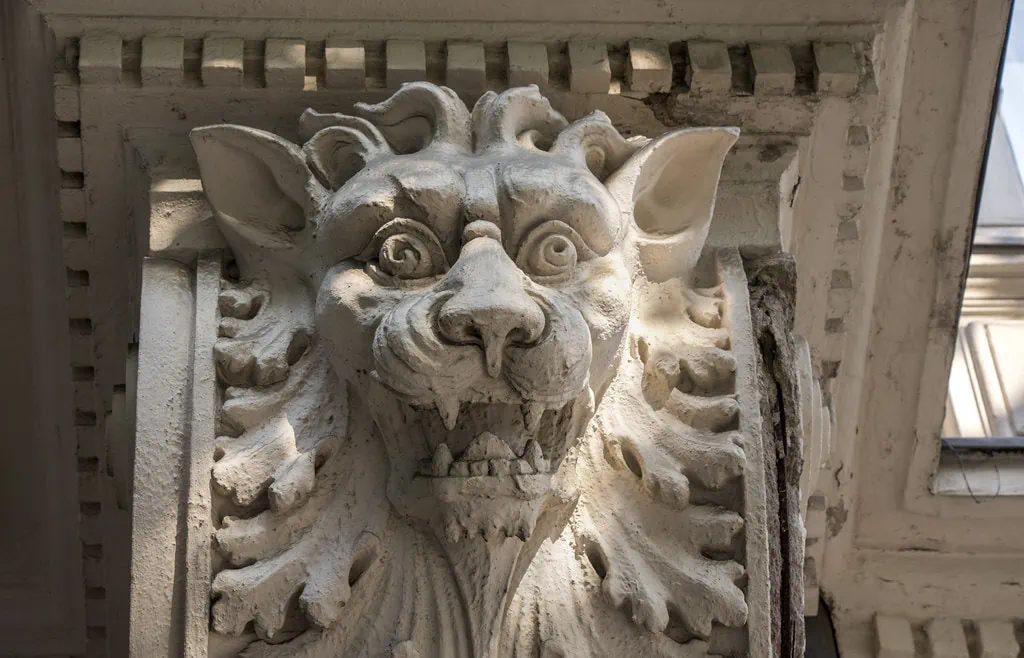
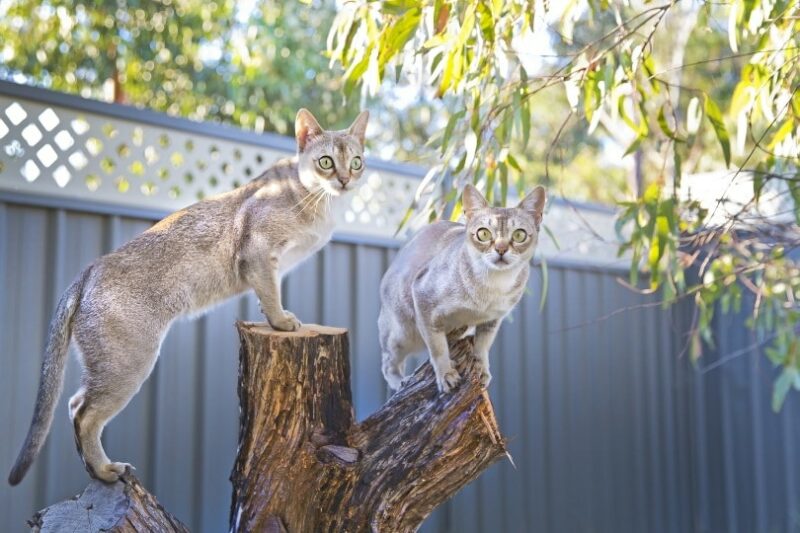
The reverence for cats has deep mythological roots. The majestic feline figures prominently in world mythology and has reigned in the world of gods and goddesses for over 30,000 years. Myths have been handed down historically as many civilizations’ way of imparting wisdom, honoring heroes, defining views on life and death, and explaining natural phenomena.
Though the oral tradition of mythtelling has evolved and changed, the mythical cats at the center of these stories have not. Here is a list of 25 cats found in mythology.
Bakeneko means “changed cat” in Japanese. Legends of Bakeneko exist all over Japan, but the most famous is the tale of the Nabeshima Bakeneko Disturbance. This cat is said to have evolved from a cat whose tail split in two as they grew old. Japanese folk legends about this cat vary, but they are considered superstitious creatures that can predict future events.
2. Ball-Tailed Cat
Kasha (Image Credit: Fearsome Critters, Written by Henry H. Tryon • Illustrated by Margaret R. Tryon, Wikimedia Commons CC0 1.0)
[su_table class=”breed-table”]
Country of Origin:
North America
Type of Entity:
Fearsome creature
[/su_table]
The ball-tailed cat has similar traits to a mountain lion but with an exceptionally long tail attached to a solid mass. Tales of the ball-tailed cat were common among woodsmen in the 20th century. Some variations of the creature include a spiked side to the tail for grappling prey.
Bastet was an ancient Egyptian goddess who was worshipped as far back as the Second Dynasty in 2890 B.C. She was originally worshipped as a powerful warrior and protector, a defender of the king and the sun god. Bastet also earned the title of goddess of pregnancy and childbirth and the goddess of protection against contagious diseases and evil spirits.
The Cabbit is a fictional hybrid animal that is a cross between a cat and a rabbit. Cabbits appear in fiction and fantasy stories in Japan, and people have reported seeing them in the wild. Such Cabbit sightings are attributed to Manx cats with bobtailed mutations and skeletal deformities.
Cactus cats are bobtail-like creatures covered in thorns, with long spines extending from their legs and tails. They are said to slash cacti, removing the juice from the desert plants. They also howl throughout the night. This fearsome predator has been attributed to many desert animal attacks.
Carbunclo is a legendary cat from mining folklore in northern Chile. He is said to have a mirror on his head and eyes that glow like coal. He is also said to be the “guardian of the metals.” He manifests around the winter solstice in late June. The myth states that anyone who sees Carbunclo will find treasures.
Celtic mythology states that a cat-sith is a black fairy cat with a white spot on their chest. This cat is as large as a dog and can steal a person’s soul before the gods claim it. They do this by passing over a corpse before burial. This sparked the tradition of the “late wake.” People would watch a corpse day and night to keep the cat-sith from sneaking up before burial.
Cath Palug is a feline monster of Welsh origin. This cat is said to haunt the Isle of Anglesey and to have killed 180 warriors when Sir Kay tried to hunt it down on the island. Outside of Wales, Cath Palug is known as both the fish cat that killed King Arthur and the cat that transposed into King Arthur himself.
Cha kla is a black cat with fur that grows back to front with blood-red eyes. This nocturnal cat fears humans and will run down a hole when they see one. If someone touches Cha kla, legend states that they will soon die.
The Demon Cat, or D.C., is said to haunt the government buildings of Washington, D.C. The cat primarily haunts the White House and the Capitol Building. This legend dates to the mid-1800s when cats were brought into the building basements to kill mice and rats. Apparently, one of these cats never left, even after death. D.C. makes his home in the basement crypt of the Capitol building, which was built to be the burial chamber for George Washington.
Legend states that D.C. frequently appears before presidential elections and tragedies. Security guards allegedly spotted him the nights before the assassinations of Abraham Lincoln and John F. Kennedy. The last “official” sighting of the Demon Cat occurred in the final days of World War II.
Hombre Gato, or Catman in English, originates from a popular folktale in Argentina. Like a werewolf, he only comes out at night and preys on animals and people.
Japanese folklore describes the Kasha as a cat demon that steals corpses. He is sometimes depicted carrying the damned in a cart to hell. In temples where a Kasha is said to live nearby, funerals are performed twice, with a rock being placed in the coffin at the first funeral. This is thought to prevent the Kasha from stealing the corpse. In other areas, people place a razor on top of the coffin.
The Kilkenny cats are a pair of cats from County Kilkenny in Ireland. These two fought each other so viciously that only their tails remained after the battle. In the 19th century, these cats became synonymous with a conflict likely to ruin both sides. Later in the 20th century, their symbolism was reclaimed as a symbol of tenacity and fighting spirit. “The Cats” is now the county nickname for the Kilkenny hurling team.
In Greek mythology, Triptolemesus taught King Lyncus to become an expert in the art of agriculture. The King refused to share his knowledge with his people and tried to kill his teacher. He was turned into a lynx as punishment.
15. Lynx
Image Credit: Reimar, Shutterstock
[su_table class=”breed-table”]
Country of Origin:
Greek mythology, North America
Type of Entity:
Mysterious creature
[/su_table]
The lynx is a real animal but also a mysterious creature that is thought to be the “keeper of secrets” in North American legends. The cat symbolizes the revealing of hidden truth and the power of clairvoyance.
In Greek mythology, the lynx is the form that King Lyncus takes as punishment for his selfishness.
Mafdet was a cat goddess and ancient deity from Egypt’s first dynasty. She featured most prominently during the reign of the Pharaoh Den. She was a symbol of legal justice and capital punishment. Other associations include protecting the king’s chamber and sacred places and protecting against venomous animals, which were seen as transgressors against the gods.
A matagot is a black cat that brings wealth to a home where they are well-fed. Traditionally, this cat must be lured with fresh chicken. Then, the new owner must carry the cat home without ever looking back. If a matagot is given the first mouthful of food and drink at every meal, the owner will be repaid with a solid gold coin each day.
This cougar- or jaguar-like entity is a real animal that has become legendary. The species of this cat has never been identified, so their size and viciousness grow with the story. They are thought to be a subspecies of cougar.
This “thunder beast” is a cat composed of white and blue lightning. They fly around like a ball of lightning, and their cry sounds like thunder. This cat is the companion to the Shinto god of lightning. While generally harmless, the cat becomes agitated during thunderstorms, leaping in trees, fields, and between buildings. Objects struck by lightning are said to have been struck by Raiju’s claws.
Splintercat is a ferocious nocturnal cat that flies through the air and knocks over trees, leaving behind a silvery ghost. The act of breaking trees with his head causes the cat to have a headache, so he’s always in a foul mood. The legendary cat is the inspiration for the naming of Splintercat Creek in northern Oregon.
21. Tepēyōllōtl
Image Credit: Toriyama Sekien, Wikimedia Commons Public Domain
[su_table class=”breed-table”]
Country of Origin:
Aztec mythology
Type of Entity:
God
[/su_table]
Tepēyōllōtl was the Aztec god of darkened earthquakes, caves, echoes, and jaguars. He is most often depicted as a jaguar and is the god of the Eighth Hour of the Night. He rules over the third day on the calendar.
The underwater panther is one of several indigenous mythological water creatures. Called Mishipeshu in Ojibwe, this mythical cat is popular among the Anishinaabe people. The name translates literally to “great lynx.” This animal has the paws and head of a cat, with dagger-like spikes along their back and tail.
The underwater panther is the most powerful underworld being, and they are traditionally considered the master of all underwater creatures. They are most often viewed as malevolent and vengeful creatures that bring death and misfortune.
The Wampus is a mythical green-eyed cat with occult powers. He is attributed to Cherokee mythology as the cat-like embodiment of a female onlooker. This woman was cursed by tribal elders as a punishment for hiding under a wildcat pelt to spy on a sacred ceremony.
In Chinese culture, the tiger is considered the king of the beasts. It is said that a tiger’s tail will turn white when they reach 500 years of age. It is also said that the white tiger will only appear when the emperor rules with absolute virtue or there is peace in the world.
During the Han Dynasty, the white tiger was worshipped as a god, symbolizing power and the army.
Icelandic tradition notes that a huge and vicious cat called the Yule Cat (Jólakötturinn) lurks in the countryside at Christmas and eats people who haven’t received new clothes to wear before Christmas Eve. He is the house pet of the giantess Grÿla from Norse mythology. Written accounts of the Yule Cat were popular in texts up until the 19th century.
Conclusion
Cats have frequently appeared in myths, legends, and folktales from around the world. While they were worshipped as gods and deities in Ancient Egypt and Greece, they were feared by Indigenous people in North America and were stealers of souls throughout Celtic and Norse history. While some of these superstitions are humorous to us now, the traditions sparked by these mythical creatures still exist today. Big or small, domestic or wild, cats are intricately woven into our history.
Chelsie is a freelance writer who is passionate about helping pet owners and beloved animals live their best lives. She lives in rural Alberta, Canada with her husband and two sons. She is also currently a pet parent to four horses, four cats, and a border collie.
We apologize for the inconvenience of this extra signup step. However, bots were subscribing to our list in huge numbers, so we had to add this extra step.